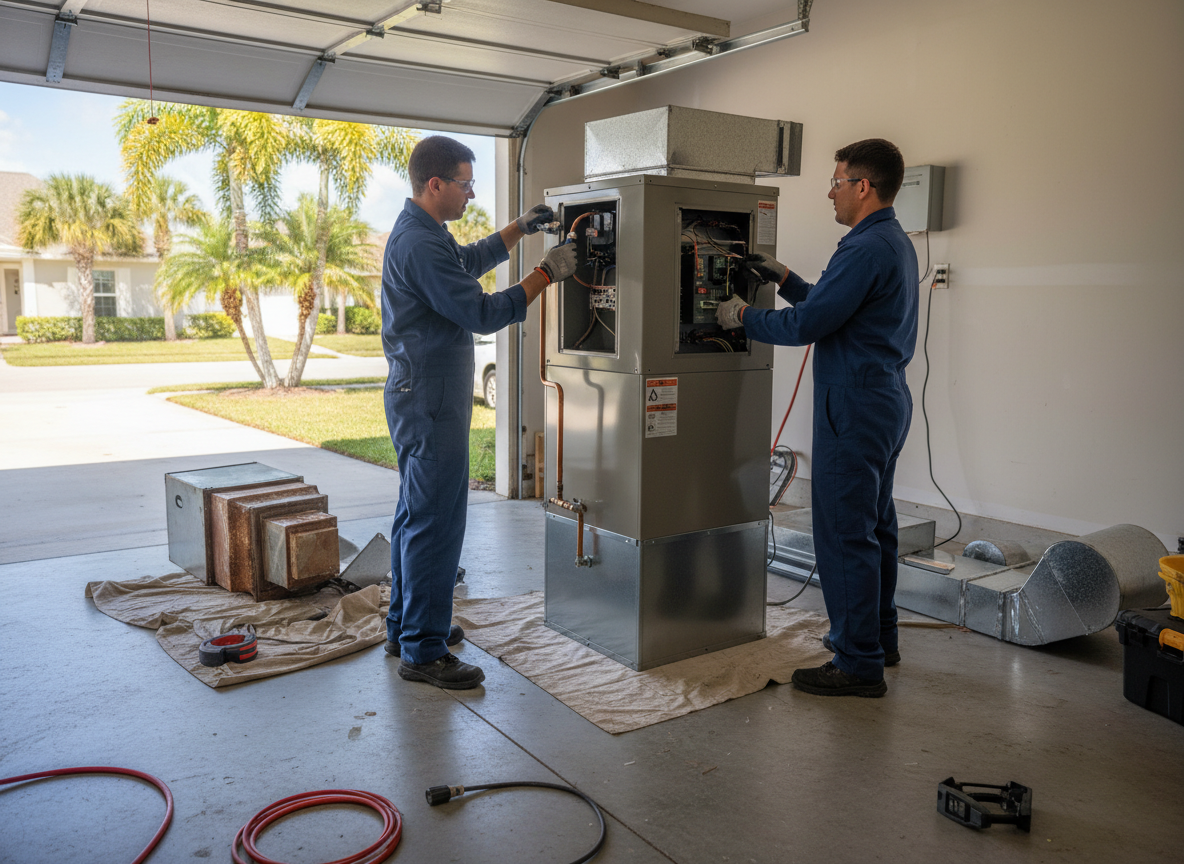
Heating repair in Sarasota usually means a heat pump, not a furnace. When a system that cooled perfectly in September blows cool air in January, the fault is somewhere in the reversing valve, the defrost cycle, the auxiliary heat or the controls that decide which of them should be running. The work is to test that chain in order rather than replace the first part that looks tired.
What heating repair covers here
The heating side of a Florida system is the same equipment that cools the house, running in the other direction until the outdoor temperature falls far enough that auxiliary heat takes over. On a heat pump that means the reversing valve, the outdoor coil and fan, the defrost board and its sensors, the compressor and its contactor and capacitor, the refrigerant circuit, the indoor coil, the auxiliary electric strips, the sequencer or relay that stages them, and the thermostat that decides when to call for them.
Where the house heats with electric resistance alone, the equipment is simpler and the faults are different: sequencers, heating elements, limit switches, contactors and the blower. Where the house has a gas furnace, that work is covered on the furnace repair page. This page deals with the systems that heat without a flame, plus the distribution and controls that every heating system depends on.
The distribution side matters as much as the equipment. A heat pump delivers air at a lower temperature than a furnace, which means ductwork that leaks or is undersized will show up first as a cold room rather than as a failed component. Dampers that have never been balanced, returns that are too small and supply runs that were tapped off for an addition all belong in a heating repair assessment.
Controls are the third layer. A thermostat that is configured for a gas furnace, with no auxiliary heat lockout and no staging, will run strip heat when the heat pump could have done the job, or refuse to bring the strips on when the outdoor unit is struggling. Setting up a heat pump thermostat is not the same as setting up a furnace thermostat, and a surprising share of comfort complaints end there.
Signs the heating system needs attention
Air that never gets warm is the commonest complaint, and it has several innocent explanations before it has a guilty one. A heat pump in January delivers air at roughly body temperature, so a register that feels tepid can be working correctly. What is not normal is air that starts warm and cools through the cycle, air that stays at room temperature indefinitely, or a system that runs continuously without moving the thermostat.
Ice on the outdoor unit is worth understanding rather than panicking about. A heat pump in heating mode frosts its outdoor coil as a normal part of operation, and the defrost cycle melts it. Ice that persists, builds into a solid block, or appears with the outdoor fan stopped points at a defrost fault, a sensor problem or a reversing valve that is not switching. Ice in a Sarasota winter is a symptom, not weather.
Auxiliary heat that runs constantly is the other side of the same coin. If the strips are carrying the load, the heat pump is not doing its share, whether because of low refrigerant charge, a failing compressor valve, a stuck reversing valve or a defrost cycle that never completes. It is also the most expensive way to heat a house, so it is worth diagnosing rather than living with.
A system that trips its breaker, hums without starting, or restarts every few minutes has an electrical fault: a failing compressor, a weak capacitor, a contactor with pitted points, a loose connection or a control board. A thermostat with a blank display, a schedule that ignores the setpoint, or an emergency heat setting that will not turn off is a controls fault, and it is diagnosed at the low-voltage side before anything in the outdoor unit is touched.
Noise and water are the last two signals. A screech from the indoor blower, a rattle from the outdoor fan, a clicking contactor that never latches and a gurgling refrigerant line all point somewhere specific. Water in the secondary pan, a ceiling stain under an attic air handler, or a condensate line that has stopped draining is a humidity and drainage problem that will damage the house long before it affects comfort.
How a heating repair call runs
The visit starts with the thermostat and the mode. Is the system set to heat, is the setpoint above room temperature, is the schedule overriding it, and what is the thermostat asking the equipment to do? Reading the call for heat, including whether it is asking for auxiliary heat, tells the technician which part of the sequence should be running before anything is opened.
Next comes the indoor unit: the air handler, the blower, the strips and the limits. The filter is checked, the blower is confirmed to be moving the right amount of air, and the electric strips are tested for current draw rather than assumed to be working because the breaker is on. A failed strip often leaves the system running on fewer stages than the thermostat believes.
The outdoor unit comes next in heating mode. Refrigerant pressures, the reversing valve, the outdoor fan, the defrost sensors and the compressor windings and capacitor are checked against the conditions at the time. Heating-mode pressures read differently from cooling-mode pressures, and interpreting them requires knowing the outdoor temperature and the indoor airflow at that moment.
The diagnosis is then confirmed rather than inferred. A reversing valve that is suspected of sticking is proved by temperature across the valve; a defrost fault is proved by forcing a cycle and watching what the board does; a low charge is proved by subcooling or superheat rather than by the feel of a line. Only then is a part discussed.
The repair is completed, the system is run through a heating cycle and a defrost cycle where conditions allow, and the supply temperature and temperature rise are measured. The thermostat settings, the auxiliary heat lockout and the filter are confirmed before the visit ends, because a system that is repaired but misconfigured will be back.
What the work includes
Heating repair covers the whole chain that delivers warmth: the call from the thermostat, the outdoor unit, the indoor unit, the auxiliary heat and the air distribution. A visit that fixes a component while leaving an unbalanced duct system or a thermostat in the wrong mode has not finished the job.
- Heat pump heating-mode diagnosis, including reversing valve testing
- Defrost board, sensor and cycle testing
- Compressor, contactor and capacitor testing
- Refrigerant charge assessment by superheat and subcooling
- Outdoor fan motor and blade service
- Electric strip heat, sequencer and limit testing
- Air handler blower, wheel and motor service
- Thermostat configuration, staging and auxiliary heat lockout
- Duct and return assessment where rooms stay cold
- Condensate and drain pan checks on attic and closet systems
- Supply temperature and temperature rise measurement at handover
Consumables belong to the repair as much as the part does. Contactors, capacitors, wire terminals, thermostat cable, drain traps and pan float switches are the items that fail quietly and cause repeat visits. Where a safety device has operated, the cause is found and corrected rather than reset.
The handover explains the system in terms the owner can use: how the heat pump and the strips share the load, what the auxiliary heat light means, what the defrost cycle sounds like, and which filter the air handler takes. A heat pump that is misunderstood gets emergency-heat calls that were never faults.
Sarasota conditions that affect heating systems
The first is the shape of the year. Cooling runs for most of it and heating for a few weeks, so the heating side of a heat pump is the less-exercised half of the equipment. Reversing valves that sit in one position for months can stick when they are finally asked to move, and defrost boards that have not cycled since March can fail on the first cold night.
The second is humidity. Sarasota's summers are long and wet, with August averaging about nine inches of rain in the NOAA normals for the airport, and an air handler in an attic or closet lives in that humidity all year. Condensate lines block, pans corrode, and drain float switches stick. Those are cooling-season problems that surface in heating season when the pan is finally looked at.
The third is salt and coastal exposure. The city limits include Lido Key, St. Armands Key, Bird Key and the northern end of Siesta Key, and salt spray reaches inland. Outdoor coils, fan blades, cabinet screws and contactor points corrode. On island properties, a heating fault is as likely to be a corroded terminal as a failed component.
The fourth is the housing. Mid-century houses associated with the Sarasota School of Architecture often have the air handler in a closet or chase with limited clearance, which affects airflow and access. Later construction puts it in the attic, where the secondary pan, the float switch and the drain route matter more than the equipment label.
The fifth is the grid. Atlantic hurricane season runs from June 1 to November 30, and Milton's landfall at Siesta Key in October 2024 left parts of the county without power for days. A heat pump that has been off for a week in humid weather comes back to a house full of moisture, and a board that has taken a surge on restoration should be assessed before the system is run hard.
Heating installation in Sarasota
Heating installation is covered here because in this climate it is rarely a separate system. A new heat pump is installed as a matched pair with the indoor unit and the ductwork, and the heating performance is decided by the same commissioning measurements that decide cooling performance: airflow, charge and control configuration.
The design starts with the load. Sarasota's mild winter means the cooling load usually sets the equipment size, and the heating capacity that comes with it is then checked against the house's heat loss at design conditions. Where the equipment's heating output at low outdoor temperature falls short, the auxiliary strips are sized to make up the difference rather than left to chance.
The installation itself covers the outdoor unit's pad, clearances and drainage; the line set and its insulation; the indoor coil and air handler; the electrical supply and disconnect; the thermostat cable and the low-voltage controls; the condensate route; and the duct connections. On a replacement, the existing line set and ductwork are assessed rather than assumed to be reusable.
Commissioning is where a heat pump installation earns its keep. Charge is set by weight or by superheat and subcooling, airflow is measured, the thermostat is configured for a heat pump with the correct staging and auxiliary lockout, and the system is run in both modes. The defrost cycle is checked and the owner is shown what normal operation sounds and looks like.
The permit is part of the work. A heat pump or air handler installation is permitted, handled through the City of Sarasota's Development Services department inside the city limits or Sarasota County for unincorporated addresses, with the inspection covering the electrical, the clearances and the condensate provisions.
Heating maintenance in Sarasota
Maintenance on a Florida heating system is mostly about the parts that sit idle. The filter is the first and simplest item, and a filter that is changed on schedule does more for airflow, electricity use and equipment life than any additive or treatment. The size and the interval belong to the household, not to a generic calendar.
The second item is the outdoor unit. Coil cleaning, clearance from vegetation and a check of the fan blade and motor are done before the heating season, because a coil that is blocked in September is still blocked in January. On the coast, terminals and contactor points are inspected for corrosion that inland equipment never sees.
The third is the condensate system. The primary drain is cleared, the secondary pan is checked, and the float switch is tested rather than assumed. In a Sarasota attic this is the item most likely to prevent water damage, and it costs nothing to test while the unit is open.
The fourth is the electrical side: capacitors measured rather than eyeballed, contactors inspected for pitting, and the blower wheel checked for balance and dirt. A weak capacitor is the most common cause of a motor that fails in the middle of a season, and it is visible long before it fails.
The fifth is the defrost and control sequence. The defrost cycle is initiated and observed, the thermostat is checked for the right mode and schedule, and the auxiliary heat lockout is confirmed. A maintenance visit that skips this has checked the equipment but not the system.
Maintenance does not prevent every failure, and it should not be sold as if it does. What it does is catch the items that fail predictably, keep the airflow where the equipment needs it, and give the owner a baseline so that a change in behaviour is noticed rather than endured.
Related heating work
The items below are the parts of heating work that come up alongside a repair, and each is handled during the visit rather than as a separate appointment.
Heating Repair Services We Offer
✓Reversing Valve and Defrost Repair
A heat pump that will not switch to heating, or that ices up and stays iced, usually has a reversing valve, defrost board or sensor fault. The cycle is observed and the valve proved by temperature.
✓Auxiliary Heat and Strip Repair
Electric strips, sequencers and limits are tested for current draw. Strips that never come on leave the house cold; strips that never switch off make the heat pump look worse than it is.
✓Compressor, Contactor and Capacitor
A humming outdoor unit that will not start is an electrical fault until proven otherwise. Windings, contactor points and capacitor values are measured before a compressor is condemned.
✓Refrigerant Charge Assessment
Heating-mode performance depends on charge. Superheat and subcooling are measured against the conditions rather than judged by the feel of a line.
✓Thermostat Configuration
Staging, auxiliary lockout, schedule and mode are set for a heat pump rather than a furnace. A misconfigured thermostat produces comfort complaints that no part will fix.
✓Airflow and Duct Correction
Cold rooms are often distribution problems. Static pressure, return size and supply runs are assessed so the equipment is not blamed for a duct that cannot carry the air.
✓Condensate and Pan Service
Drains, traps, pans and float switches are cleared and tested, which matters most where the air handler sits above living space.
✓Seasonal Heating Check
Filter, outdoor coil, electrical components, defrost cycle and thermostat are checked before the heating season so the first cold night is not the first test.
How it works
- 1
Read the Call for Heat
The thermostat mode, setpoint, schedule and auxiliary heat request are confirmed before the equipment is opened, since a control fault upstream changes everything.
- 2
Check the Indoor Side
Filter, blower, electric strips and limits are tested for airflow and current draw. A strip that is not energising leaves the system running below its capacity.
- 3
Test the Outdoor Unit
In heating mode, pressures, the reversing valve, the outdoor fan, defrost sensors and the compressor circuit are checked against the conditions at the time.
- 4
Prove the Fault
The suspected part is confirmed by measurement: temperature across the reversing valve, a forced defrost cycle, subcooling or superheat, or a capacitor value.
- 5
Repair and Reconfigure
The part is replaced with new consumables, and the thermostat staging and auxiliary lockout are set so the system runs as designed rather than on emergency heat.
- 6
Measure and Explain
Supply temperature and rise are measured across a heating cycle, and the defrost cycle, filter and auxiliary heat behaviour are explained before the visit ends.