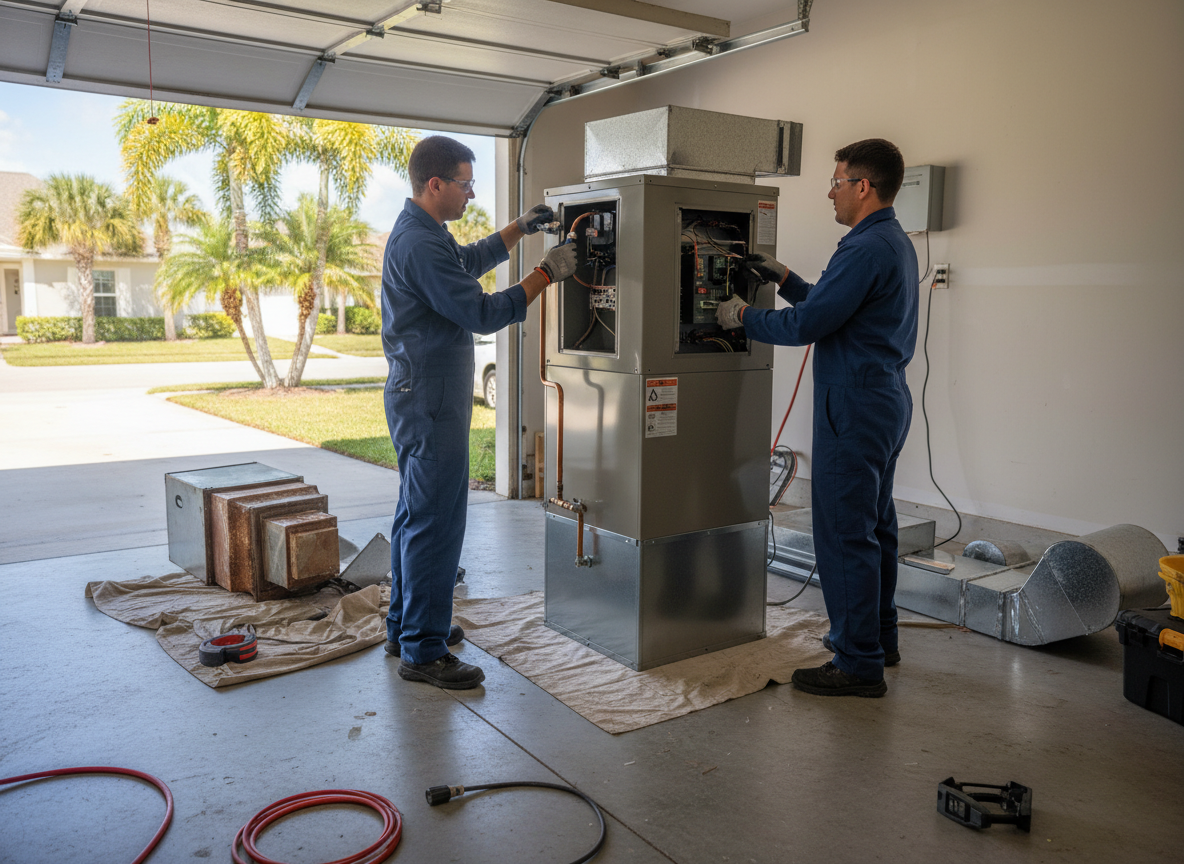
Furnace repair in Sarasota starts with the ignition sequence, not with a replacement proposal. A gas furnace that will not light, an electric furnace that runs without warming, or a unit that fires for ninety seconds and shuts down has failed at a specific step in a fixed order. The job is to find which step, and to prove it before a part is fitted.
What furnace repair covers in a Sarasota house
The scope runs from the thermostat's call for heat to the last foot of supply duct. On a gas furnace that means the low-voltage circuit, the ignition source, the gas valve and manifold, the burners, the inducer and its pressure switch, the flame sensor, the high-limit and rollout switches, the flue and the heat exchanger, the control board, the blower and its capacitor. On an electric furnace it means the sequencer, the elements and their limits, the contactor, the wiring and the blower. Those two lists overlap at the blower and the thermostat and almost nowhere else.
A repair is different from a maintenance check in one important way: it starts from a reported symptom and works backwards to a cause. A maintenance check assumes the equipment works and inspects it. A repair assumes something has failed and proves which item it was. That difference is why a repair visit begins with questions about what the heat did and when, rather than with a checklist.
Some findings are not repairable, and it is worth saying so at the start. A heat exchanger that has cracked through, a flue that has rusted from the inside out, or a cabinet that has rotted where condensate has been running for years are conditions where repair becomes a decision about the whole unit. Those are the exceptions. Most no-heat calls end with a part, not a replacement.
The other boundary is the house itself. Airflow, gas pipe size, the electrical circuit and the flue's route all decide whether a furnace can work at all, and none of them live inside the cabinet. A furnace that trips its high limit on every cycle is usually telling you about a filter, a coil or a crushed duct rather than about itself.
Signs that point to the furnace rather than the thermostat
No heat at all is the plainest symptom, and on gas equipment it usually resolves to one of five things: no call from the thermostat, no ignition, no flame proving, no draft, or no gas. Each is testable in minutes. An electric furnace with no heat is usually a sequencer that has failed open, an element that has burned through, or a limit that has opened and stayed open because the airflow is restricted.
A furnace that fires and then shuts down after a minute or two is a different problem. On gas, a flame sensor coated in oxide will not prove flame, so the board closes the gas valve as a safety measure. A pressure switch that cannot close because the inducer is weak, the flue is blocked or the condensate trap is full does the same thing. On an electric unit, a limit switch cycling on temperature says the same in a different language: heat is being produced faster than the air is carrying it away.
Short cycling has a second, quieter cause. An oversized furnace satisfies the thermostat quickly, shuts off, and repeats. A house that heats in short bursts all winter is often running equipment selected for a larger load than the ductwork can move, which is a distribution problem wearing a furnace costume.
Noises are diagnostic. A boom or thud at ignition is delayed ignition, where gas has built up before it lights; the cause is usually a dirty burner, a lazy igniter or a gas valve that opens slowly. A rattle at start-up can be a loose panel or a failing inducer bearing. A screech is a blower bearing. A whistle at a register is a restriction, and a hum from the transformer with no fan is a control circuit problem.
Smells matter. The dusty smell on the first run of the season is normal and burns off. A metallic or overheated smell, a smell of gas at the cabinet, or exhaust that leaves soot on the flue collar are not normal. A gas smell in particular means the unit should be shut off at the valve rather than investigated by the occupant.
A tripped breaker, a blower that runs continuously, a thermostat display that is blank, or a furnace that only works when the panel is tapped all point at electrical faults: a shorted element, a failing board, a loose connection or a thermostat that has lost its low-voltage supply. Those are as much furnace repair as a failed igniter is.
How a furnace repair visit runs
It begins with the data plate. Make, model, input rating, fuel and the date code establish what the unit is meant to do, and the age tells the technician what to expect inside it. A twenty-five-year-old furnace and a five-year-old one fail in different places, and the age shapes whether a repair is worth doing at all.
The thermostat comes next, because a furnace cannot fix a control problem upstream of it. Is it calling for heat, is the setpoint above the room temperature, is the schedule overriding it, and does the low-voltage signal actually reach the board? A fair number of no-heat calls end here, with a thermostat, a blown fuse on the board or a broken thermostat wire.
Then the sequence itself, in order. The inducer starts, the pressure switch proves, the igniter heats, the gas valve opens, flame is proved, and the blower starts after its delay. Watching that sequence rather than jumping to a part is what makes a diagnosis quick. If the inducer never starts, the pressure switch is irrelevant. If the pressure switch never closes, the igniter never gets its chance.
Once the unit runs, the measurement that matters is temperature rise: the difference between return air and supply air, compared with the range printed on the data plate. A rise above that range means restricted airflow or overfiring; below it means underfiring, a poor flame or a heat exchanger that is not transferring. It is a single number that validates the repair before the technician packs up, and it is the number most often skipped.
The repair itself follows the finding. Gaskets, burner alignment, gas pressure, flame sensor position, blower wheel cleanliness and the condensate trap on a condensing furnace are checked while the unit is open, because a second visit for something visible during the first wastes the customer's day. The unit is then run through two full cycles and the rise is re-checked.
What the work includes
A furnace repair visit covers the diagnosis as well as the part. The unit is assessed as a system, so a failed igniter on a furnace with a rusted flue is not signed off as a completed repair just because the burner now lights. Where one fault has a consequence elsewhere, that consequence is on the list before the visit ends.
- Low-voltage diagnosis at the thermostat, board and safety switches
- Hot-surface igniter, spark ignition and standing pilot faults
- Flame sensor cleaning and replacement
- Inducer draft motor and pressure switch testing
- Gas valve, manifold pressure and burner service
- High-limit and rollout switch diagnosis
- Control board and wiring faults, including board fuses
- Blower motor, capacitor and wheel service
- Electric furnace sequencer, element and limit replacement
- Heat exchanger and flue inspection before a unit goes back into service
- Temperature rise and static pressure checks at handover
Consumables are part of the job: igniter gaskets, burner gaskets, sensor screws, wire terminals and the condensate hose on a condensing unit. Reusing a hardened gasket to save ten minutes is how a repair becomes a call-back. Where a safety switch has opened, it is replaced or its cause is corrected rather than reset and forgotten.
The handover is short but specific. The repair is explained in terms of what failed and what that says about the rest of the unit, the filter size and change interval are confirmed, and any part that is approaching its limit is named. If the repair has bought a season on a furnace that is near the end, that is stated plainly.
Sarasota conditions that shape furnace faults
The first is the length of the season. Heating here runs for weeks rather than months, and equipment spends most of the year off. That idle time is when corrosion starts: burners and heat exchangers pick up surface rust in humid air, contacts oxidise, and insects build nests in flue caps and in the outdoor sections of a package unit. The first cold snap then produces a failure that has been developing since spring.
The second is salt. The city limits include Lido Key, St. Armands Key, Bird Key and the northern end of Siesta Key, and salt spray reaches well inland. Furnace cabinets, burner assemblies, board connectors and terminal strips corrode faster here than a service manual written for a dry climate assumes. On island properties, a technician who looks only at components and not at the terminals will miss the actual fault.
The third is gas supply. Natural gas reaches only part of Sarasota's housing, and much of the city heats with a heat pump or with electric strip heat in an air handler instead. Where gas does exist, furnaces tend to be older than the housing stock suggests, and parts for older models can take time to arrive. Where gas does not exist, the furnace work on this page is electric furnace work, and the diagnosis goes to sequencers and elements rather than to valves and flames.
The fourth is the housing. The mid-century houses associated with the Sarasota School of Architecture put equipment in closets and chases with very little clearance, and later additions sometimes enclosed the space a furnace was drawing combustion air from. A furnace that works in an open garage and fails in a sealed closet is not a faulty furnace; it is a combustion air problem, and it has to be solved before anything else is.
The fifth is storm weather. Atlantic hurricane season runs from June 1 to November 30, and Milton's landfall at Siesta Key in October 2024 showed how long outages can last. A furnace that has been flooded, or a control board that has taken a surge when the power came back, should be assessed before it is energised. It is also worth knowing that a gas furnace with a standing pilot can sometimes be lit without power, while a sealed-combustion model cannot.
Permits sit alongside those points. Repair work that does not change the appliance or its fuel is a different question from a replacement, which is permitted work through the City of Sarasota's Development Services department inside the city limits, or Sarasota County for unincorporated addresses. The authority for the specific address always has the last word.
Related furnace repair work
Most furnace faults arrive as a handful of repeat offenders. Each of the items below is handled inside the repair visit rather than as a separate appointment, since they are all part of the same sequence.
Furnace Repair Services We Offer
✓Hot-Surface Igniter Replacement
A cracked or weakened igniter will not draw enough current to open the gas valve. It is tested for resistance and inspected for cracks rather than replaced on suspicion.
✓Flame Sensor Cleaning and Replacement
The sensor proves flame to the board. Oxide on its tip is the most common reason a furnace lights and then shuts down within a minute, and it is a cleanable fault more often than a failed part.
✓Inducer Motor and Pressure Switch
The inducer pulls combustion gases through the flue and proves draft through a pressure switch. Weak motors, blocked flue paths and full condensate traps all present as the same no-heat symptom.
✓Gas Valve and Burner Service
Manifold pressure, burner alignment and orifices are checked where ignition is delayed, the flame is lazy or the unit is overfiring. A gas smell at the cabinet is a shut-off-and-assess situation.
✓Control Board and Low-Voltage Faults
Blank displays, a blower that never stops and a furnace that ignores the thermostat are board and wiring questions. Fuses, terminals and the low-voltage harness are tested before a board is condemned.
✓Blower Motor, Capacitor and Wheel
A blower that is slow, noisy or stops when warm affects both heat and cooling. Capacitors, bearings and a dirty wheel are checked together, because one failing accelerates the others.
✓Electric Furnace Elements and Sequencers
Electric furnaces fail at the sequencer, an element or a limit rather than at a flame. Elements are tested for continuity and current draw, since a failed element can look perfectly intact.
✓Heat Exchanger and Flue Inspection
The heat exchanger is checked for cracks and the flue for corrosion and correct slope before any gas unit is returned to service. A failed exchanger changes the decision from repair to replacement.
How it works
- 1
Record the Unit
Make, model, input rating, fuel and date code are recorded, along with where the furnace sits and how it is vented. That sets the expected behaviour before any test begins.
- 2
Check the Call for Heat
The thermostat is confirmed to be calling, with the setpoint above room temperature and no schedule override, and the low-voltage signal is checked at the board.
- 3
Watch the Sequence
Inducer, pressure switch, ignition, gas valve, flame proving and blower are observed in order. The first step that fails is the one to test.
- 4
Measure the Result
Temperature rise is compared with the data plate range, and static pressure is checked where airflow is suspect. A repair that does not restore the rise has not restored the furnace.
- 5
Carry Out the Repair
The confirmed part is replaced with new gaskets and terminals, and anything visible while the unit is open that would cause a second visit is dealt with at the same time.
- 6
Run Two Cycles
The furnace is cycled twice and re-measured, and the filter, disconnect, gas shutoff and venting are pointed out before the technician leaves.