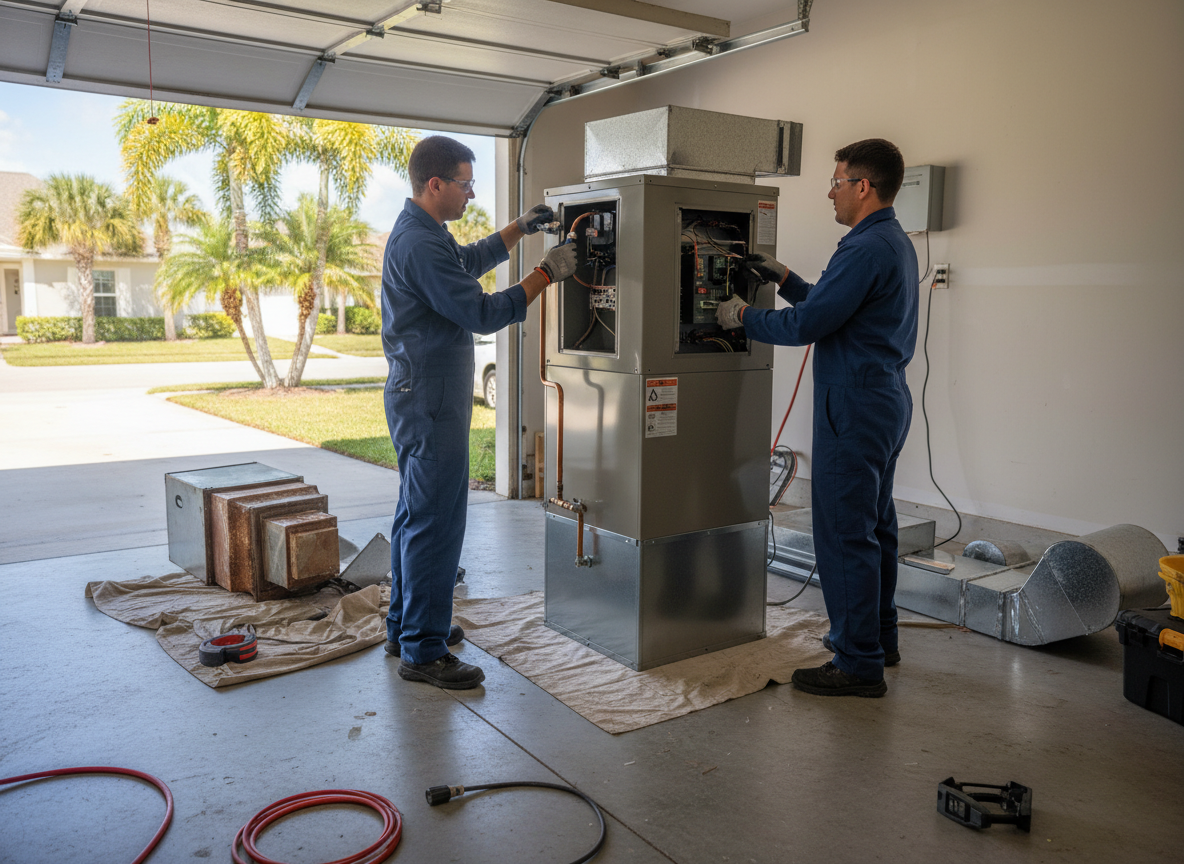
Furnace replacement in Sarasota is the answer when a unit has failed in a way that cannot be repaired, or when repairing it again would cost more than the remaining life is worth. The useful question is not how old the furnace is but whether the heat exchanger is sound, whether parts still exist for it, and what the rest of the system around it looks like. Everything else follows.
When replacement is the right answer
A cracked heat exchanger is the clearest case. When the boundary between combustion gases and the air being delivered into the house has failed, the unit cannot be made safe by replacing a component, and no amount of cleaning changes that. A flue that has corroded through, or a cabinet rotted where condensate has been running, points the same way.
A second case is parts. A control board, a gas valve or an inducer that is no longer manufactured for an older model turns a straightforward repair into a search, and a furnace waiting weeks for a part in a Sarasota January is not much use. Where the part exists but the unit is at the end of its expected life, the decision becomes a judgement about how soon the next failure arrives.
A third case is repeated failure. One igniter in ten years is normal. Three in two seasons suggests something else is wrong, whether it is a board sending the wrong signal, moisture in the cabinet or a gas supply problem. When the same fault keeps returning, the honest answer is often that the unit has become the problem rather than the place where the problem shows.
A fourth case is capacity. A house that has gained an addition, a converted garage or a glazed sunroom may now ask more of the furnace than it was selected for. Equipment that runs continuously in cold weather and still cannot hold temperature is not faulty; it is undersized for what the house has become, and replacement with a correctly sized unit is the fix.
The opposite case matters too. A furnace with a sound heat exchanger, a working inducer and a board that is still available is a candidate for repair regardless of its age. Replacing a unit because a technician prefers new equipment, rather than because the evidence points that way, is a decision the customer should be able to see through.
What a furnace replacement involves
The scope covers removal, inspection of what the old unit was sitting on, correction of anything that would fail an inspection, installation of the new unit, and commissioning. It also covers the decisions that surround a changeout: what fuel and venting the new unit will use, whether the ductwork and return are adequate, and whether the electrical or gas supply needs to change.
Removal is more than disconnecting. The old unit is isolated from gas and power, the flue is disconnected, the condensate is drained, and the cabinet is taken out along whatever route it came in by. In a Sarasota closet or attic that route may be tight, and the plan for getting a heavy cabinet out without damaging walls or ceilings is part of the job.
What the old unit was sitting on is inspected once it is out. Platforms rot, drain pans crack, and condensate that has been escaping for years leaves a stain and soft board behind it. None of that is visible while the furnace is in place, and none of it should be covered up by the new installation.
Code corrections usually appear at this point. A replacement is the moment when a missing secondary drain pan, a single-wall flue connector where double-wall is required, a gas connector that has been in place for two decades, a shutoff that does not close fully, or a vent termination too close to an operable window has to be dealt with. Those items are not invented for the invoice; they are what an inspection looks for.
The new unit is then set, connected, vented and commissioned in the same way as a new installation: gas pressure set, temperature rise measured within the data plate range, static pressure checked, condensate trap primed and the unit cycled. The old unit is removed from the property, which is part of the work rather than something left at the kerb.
How a replacement runs
The day starts with confirmation rather than demolition. The new unit is checked against the specification, the existing gas or electrical supply is verified to suit it, and the removal route is walked before anything is disconnected. A changeout that discovers a problem at four in the afternoon is a changeout that was not planned.
Isolation comes next: gas off at the valve, power off at the disconnect, flue disconnected with the space ventilated. The old cabinet is removed and the opening inspected. Anything that needs to be corrected underneath or behind it is corrected now, while it is accessible.
The new unit is set level on a sound base, with the correct clearances to combustibles and enough room to open the panels for service. The venting is installed to the manufacturer's specification and the local code, the gas piping or electrical circuit is connected, and the condensate route is completed and trapped.
Commissioning is the proof. The unit is fired, gas pressure is set, the temperature rise is measured and adjusted, static pressure is recorded, and the system is cycled to confirm that ignition, blower delay and shutdown all happen in the right order. The thermostat is configured, and the owner is walked through the filter, the shutoff, the vent termination and the drain.
Where a permit applies, the inspection is scheduled and completed before the job is considered closed. The permit is not a formality in Florida; it is the point at which the venting, combustion air and clearances are checked by someone who did not install them.
What the work includes
A replacement includes the assessment that justifies it. The condition of the heat exchanger, the availability of parts, the history of failures and the state of the ductwork are all part of the recommendation, and the reasoning should be visible to the owner rather than delivered as a verdict.
- Removal and disposal of the old furnace and its flue connector
- Inspection of the platform, pan and cabinet opening once the old unit is out
- New secondary drain pan and float switch where the code requires one
- Venting to the manufacturer's specification and the local code
- Gas piping or electrical supply verified and corrected where needed
- Duct transitions and return corrections where the distribution is inadequate
- New thermostat where the existing one does not suit the equipment
- Commissioning: gas pressure, temperature rise, static pressure, cycle testing
- Permit application and inspection coordination where required
- Handover covering filter, shutoff, drain and vent termination
Replacement also includes the parts that are not the furnace. A flue connector, a gas connector, a thermostat cable, a filter grille and a drain trap are all consumables in the life of an installation, and reusing tired ones is how a new unit inherits an old problem. The decision on each is made on condition rather than on convenience.
What it does not include is a promise that every house can take a like-for-like swap. A change in fuel, a move from an atmospheric furnace to a condensing one, or a change from a closet to an attic location changes the venting, the drain and the electrical work. Those are set out in the plan for the replacement rather than discovered afterwards.
Sarasota conditions that decide the timing
The season shapes when a replacement should happen. Heating here runs for weeks, not months, so a failure in January is urgent and a unit that is merely tired can be replaced in the shoulder months when parts, equipment and inspection schedules are less stretched. NOAA's normals for Sarasota-Bradenton show an average January low near 52F, which means most of the year is available for planned work.
Salt determines what the new cabinet should be able to survive. On the barrier islands inside the city limits, including Lido Key, St. Armands Key, Bird Key and the northern end of Siesta Key, corrosion attacks cabinets, burners and terminals. A replacement on the islands is an opportunity to think about where the unit sits and what it is exposed to, not only about which model to fit.
The housing stock determines the physical work. Mid-century houses associated with the Sarasota School of Architecture often have a closet or chase rather than an attic, and a like-for-like swap has to fit the same opening. Houses built from the 1980s onward more often have the air handler in the attic, where a replacement includes the platform, the pan and the route in and out.
Storm season affects the calendar as well. Atlantic hurricane season runs from June 1 to November 30, and Milton's landfall at Siesta Key in October 2024 showed how quickly a normal week can turn into an outage. Replacing a unit before the season, rather than in the middle of it, keeps the work off the critical path when contractors and inspectors are stretched.
Permits are part of the timing. A replacement in Florida is permitted work, handled through the City of Sarasota's Development Services department inside the city limits or Sarasota County for unincorporated addresses. Inspection availability varies through the year, and a plan that ignores it produces a completed installation that cannot be closed out.
Finally, gas availability decides what can be replaced with what. A house with a gas main can keep a gas furnace, and a house without one will be replacing an electric furnace or an air handler with strip heat. Converting in either direction is a bigger job than a swap and should be planned as one.
Related replacement work
A replacement tends to pull a few other jobs along with it. The items below are the ones that most often come up at the same time, and each is handled as part of the changeout rather than left for a separate visit.
Furnace Replacement Services We Offer
✓Heat Exchanger Assessment
The decision to replace usually rests on the heat exchanger. It is inspected for cracks, corrosion and distortion before a repair is recommended on an older unit.
✓Removal and Disposal
The old furnace, its flue connector and any failed components are removed from the property, with a route planned for tight closets and attic access.
✓Platform and Pan Repair
Rotting platforms, cracked pans and water damage underneath an old unit are found when it comes out, and repaired before the new cabinet is set.
✓Venting Correction
A replacement is where flue material, slope and termination are brought up to the current requirement, including the switch to PVC for a condensing furnace.
✓Gas or Electrical Upgrade
The existing gas pipe or electrical circuit is verified against the new unit's rating and corrected where it does not suit, rather than assumed to be adequate.
✓Duct and Return Correction
Undersized returns and crushed runs limit any replacement. They are identified during the changeout so the new equipment is not installed onto a known restriction.
✓Condensate Route
A condensing replacement needs a trapped drain with a slope that works. The route and discharge point are planned before the unit is set, not after it starts producing water.
✓Commissioning and Inspection
Gas pressure, temperature rise, static pressure and cycling are recorded, and the permit inspection is completed before the job is closed.
How it works
- 1
Confirm the Decision
The case for replacement is set out before anything is ordered: heat exchanger condition, parts availability, failure history and the state of the ductwork.
- 2
Prepare the Day
The new unit is checked against specification, the gas or electrical supply is verified, and the route in and out of the space is walked.
- 3
Remove and Inspect
The old unit is isolated and removed, and the platform, pan and opening are inspected and repaired before the new cabinet goes in.
- 4
Set and Connect
The new furnace is set level with correct clearances, vented to specification, and connected to gas or power with a new flue and gas connector where needed.
- 5
Commission
Gas pressure, temperature rise and static pressure are measured and set, and the system is cycled to confirm ignition, blower delay and shutdown.
- 6
Inspect and Hand Over
The permit inspection is completed where one applies, the old unit leaves the property, and the owner is shown the filter, shutoff, drain and vent termination.